
Bismillah al-Rahman al-Rahim
On seeing beyond forms
(Sura 6, Verses 74-79)
Visionary Unveilings
Added March 23, 2004
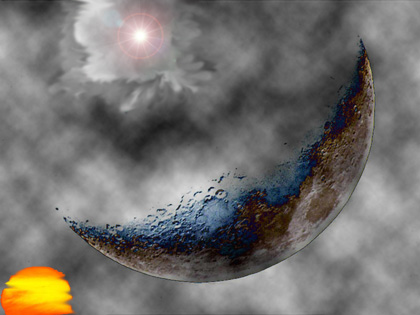
“Lo! Abraham said to his father Azar: "Takest thou idols for gods? For I see thee and thy people in manifest error. So also did We show Abraham the power and the laws of the heavens and the earth, that he might (with understanding) have certitude. When the night covered him over, He saw a star: He said: 'This is my Lord.' But when it set, He said: 'I love not those that set.' When he saw the moon rising in splendour, he said: 'This is my Lord.' But when the moon set, He said: 'unless my Lord guide me, I shall surely be among those who go astray.' When he saw the sun rising in splendour, he said: 'This is my Lord; this is the greatest (of all).' But when the sun set, he said: 'O my people! I am indeed free from your (guilt) of giving partners to God. For me, I have set my face, firmly and truly, towards Him Who created the heavens and the earth, and never shall I give partners to God.' ” (Qur'an 11:5)
Note: Abraham's father was named Tarakh. He is said to have passed away before Abraham's birth. Azar is believed to possibly be the patriarchal or tribal father under whose guardianship Abraham was raised.
These verses describe the spiritual vision and state of certainty granted to Abraham as a gift from God. In a series of revelatory and intellectual unveilings, the Reality behind existence - it's true nature - was manifested and he arrived at a state of metaphysical understanding and certainty that most humans will not reach except after the blowing of the trumpet of light (that will illuminate and reveal the true nature of reality prior to the judgement).
This spiritual journey is described in the form of a series of events in which Abraham(a.s.) penetrates through the apparently stable (but actually impermanent and shifting) forms and interacting physical laws of the material world to perceive the foundational source of existence. He first turns away from the materialistic, frozen spirituality of his people who have tried to give fixed material form (idols) to that which is beyond all form and who have thus transformed spirituality into idolatry.
Then begins a series of perceptions which take Abraham beyond all forms. He perceives three heavenly lights each more intense than the previous one but each one is subject to laws and to time since each one sets (each is demarcated and limited and subject to natural laws, each one is contingent in its interactions with a greater system). So then he turns to face what is beyond each appearance. True knowledge has a vastness that is beyond any narrowness - and seeking deep knowledge transforms the one who seeks it, and with each transformation the seeker is prepared for even deeper and a more vast knowledge. Just as when Allah grants a revelation to a Prophet or an inspiration to a servant, it prepares the servant for further inspiration, and this goes on endlessly. The gaining of this type of knowledge is like the removal of veils. With each removal you think that now you are truly seeing the essence but the next removal makes you aware that this is not the case.
Abraham in this series of perceptions and unveilings of lights is granted a revelation, an experience that it is only “Allah that is the Light of the Heavens and the Earth”. So this series of perceptions is a revelation to Abraham and at the same time it is an instruction to his people who are caught up in worshipping forms - who are trapped in a materialistic outlook where knowledge begins and ends at this lowest level of existence. This is phrased as an instruction, almost as a series of three questions to them (corresponding to the star, moon, and sun) - 'Is this what you worship' - 'is this what you worship' - 'is this what you worship' - can you not penetrate with your mind beyond this level? Are the forms of the material world all that you are capable of perceiving in your sciences, your philosophical understanding, even in your religion. Are you trapped and confined by the narrowness of your minds and do you in this manner self-limit all your knowledge and understanding? Are you not aware that the splendor of even the heavenly lights is subsumed by the Source of all light.
So it is at once a revelation to Abraham of the unity of Allah and the veiled and limited nature of this world, and an instruction to Abraham's tribe of their error, and a visionary appeal for them and for all of us to expand beyond our self-imposed limits. Between where knowledge currently stands to the threshold of God's throne lies a vast landscape of knowledge, an undiscovered country of immeasurable treasures that awaits the perspicacious seekers for whom insight and illumination open an uplifting path for a humanity that has become too comfortable with their feet of clay, just as Abraham's people had grown too attached and comfortable to their idols of clay.[1]
“What is this image of clay (this matter, this material world) to which you are so (assiduously) devoted?”
*
To be notified when new articles are added to this site, please follow @i_from_i (islam from inside). Or, if you prefer, subscribe to the islam from inside RSS feed.
On God's Transcendence
-
1 – “Those who ascribe rivals to God (al-adilun billah) cry lies when they make Him similar to the like of their categories, adorn Him in their imaginations with the adornment of creatures, divide Him with a measure resulting from the notions of their concerns, and measure Him by the talents of their reason's powers in terms of the creatures with their multiple faculties. For how should the deliberations of imaginations assess Him whose measure cannot be determined, when surely the notions of understanding have erred in conceiving of His inmost center ? For He is greater than that the minds of men should delimit Him through thought (tafkir) or angels should encompass Him through estimation, despite their proximity to the kingdom of His might.”
“High be He exalted above having an equal (kufw) with which to be compared, for He is the Subtle: when imaginations desire to encroach upon Him in the depths of the unseen regions of His dominion, (when) thoughts (fikar) free from insinuating intrusions seek to grasp knowledge of His Essence, (when) hearts are thrown into mad confusion over Him in trying to embrace Him through conforming to His attributes, (when) the ways of approach of reason's powers become obscured since no attributes attain to Him by which they might gain the knowledge of His divinity, (then) they (imaginations, thoughts, hearts and ways of approach) are checked in disgrace while traversing the chasms of the dark reaches of the unseen worlds, rid (of all things) for Him-glory be to Him! They return having been thrown back, admitting that the inmost center of His knowledge is not reached through the deviation of straying (from the path)] and that no notion of the measure of His might's majesty occurs to the mind of meditators, by reason of His distance from being (encompassed) within the faculties of limited beings. For He is counter to (khilaf) His creation, and there is nothing like Him among creatures. Now a thing is only compared with its like (adil). As for what has no like, how should it be compared with what is other than its like (mithal)? And He is the Beginning (al-badi) before whom was naught, and the Last (al-akhir) after whom will be naught.” (Imam Ali on God's Transcendence from “A Shi'ite Anthology”)
“Whoso maintains that he knows God by means of a veil (hijab) or a form (surah) or a likeness (mithal) is an associator (mushrik), for the veil, the likeness and the form are other than He. He is utterly and only One. So how should he who maintains that he knows Him by means of other than Him be professing Unity ? Surely He alone knows God who knows Him by means of God (billah). Therefore, whoso knows Him not by means of Him knows Him not. On the contrary, he only knows other than Him. There is nothing between the Creator and the created. [96] God is the Creator of things, but not from something. He is named by His names, so He is other than His names, and His names are other than He. The described (al-mawsuf) is other than the describer (al-wasif).” (Imam Jafar al-Sadiq - from “A Shi'ite Anthology”)
↵