
Bismillah al-Rahman al-Rahim
Power and Hegemony
The Temptation of Jesus as a Paradigm for Human History
Added November 30, 2005
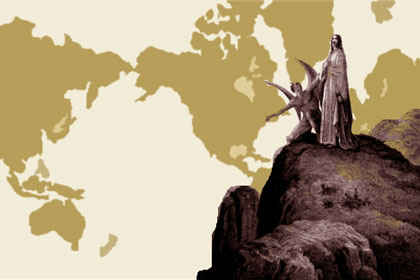
“Then leading him to a height, Satan showed him in a moment of time all the kingdoms of the world and their splendor and said to him, ‘I will give you all this power and glory of all these kingdoms....worship me then and it shall be all yours.’ Then Jesus replied, ‘Be off, Satan! For scripture says: You must worship your Lord, your God and serve Him alone.’ ” (Matthew 4:8-10)
This beautifully evocative passage from Matthew contains a succinct spiritual statement concerning the worldly history of mankind – a history replete with ambition, desire, conquest, hegemony, and empire building. Satan's offer to Jesus[1] represents the ultimate profane offer - every kingdom of the world with all the accompanying power, glory and wealth - a naked appeal to the ego and to the avaricious aspects of the nafs (soul) in its lowest state of being. We have to wonder whether Satan was so deluded as to believe that Jesus would actually succumb to such transparent bribery - perhaps it is indicative of the limits within which Satan is forced to operate - when faced with a faithful servant of God he can only increase the magnitude of his offer, not alter its nature. “Surely the strategy of the Satan is weak....” (Qur'an 4:76) Of course, Jesus easily saw the crux of the matter, and banished Satan away. The passage concludes with the statement, “Then Satan left him and angels came and attended Jesus.”
This is the case for Jesus. But this offer of Satan's - this deal with the devil is one that we can imagine has been offered again and again (in more limited but endlessly varied ways) throughout the history of mankind. Satan's offer is always present. ‘I will give you power, glory, and empire in your time - just bend towards me - a little bow, a small acknowledgement through casting aside of truth, compassion, and principle and I'll assist you on your way to conquest, hegemony, wealth, power, glory. All your ambitions realized at the expense of others.’
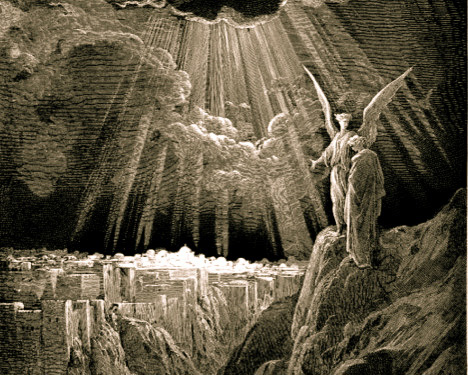
It is as if this offer has remained on the table from the beginning of human history, and every era has had its takers - snatching the bargain greedily off the table before it falls into other's hands. A history of conquests, of monopolies, of dominance, of political, military, and economic manipulation and sovereignty - that's how we're taught history - as an endless parade of pharaohs, dynasties, kingdoms, fiefdoms, sultanates, empires, dictatorships, republics, or democracies all engaged in an increasingly vicious, brutish, and nasty game of King of the Hill.
Somehow, when we come to our own time, to our own nations, we're ideologically caught up in the game and must struggle to view it with the historical perspective through which we viewed the previous scrambles for the top of the hill. Too often, we'll defend our own nation's scramble to the top, no matter how much devastation is caused while taking the hill, no matter what principles are shattered or what brazen lies are promulgated. Such measures are simply considered to be part of a realistic worldview – one in which geopolitical realities must be understood and acknowledged and a certain amount of violence and ruthlessness is considered as necessary to achieve security and deal with the harsh truths of a ruthless world.
Jesus wasn't just offered the position of King of the Hill, but that of King of the mother of all hills - a kingdom encompassing all other kingdoms past, present, and future - and he cast it aside as worthless dross. While he saw the whole of this dance of worldly dominance as inconsequential, how is it that so many others have struck the devil's bargain even for small specks of power, seeking dominion over any hillock, no matter how small or insignificant. The lure of the game is powerful, almost irresistible, it seems. And as the world shrinks with the increasingly speedy growth of technology and the advent of an age of scientific miracles, the stakes of the game become great. Technology is a vast and immensely powerful lever that extends and strengthens potential human reach and brings the possibility of control, surveillance, and dominion into jurisdictions that were previously free of interference. The stakes for those of us who live on this hill (that is, the earth) are considerable. We're arriving at an age in which everyone is affected by the game - whether we cast aside the devil's bargain or accept it, we're going to suffer the effects of the battle for the summit – there will be precious few places of refuge remaining.
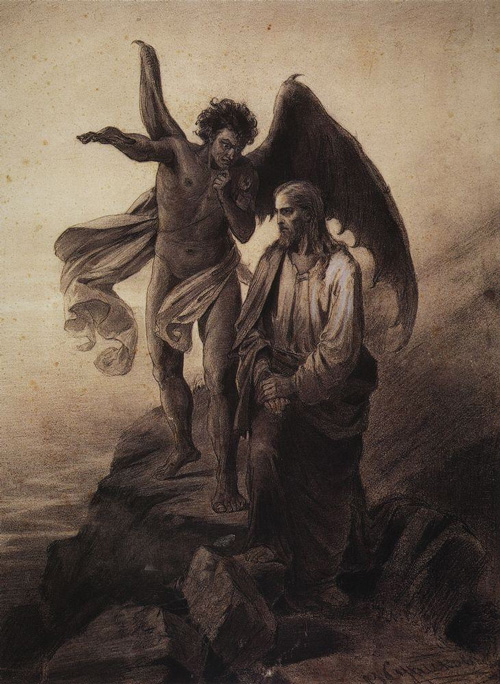
The devil's contract is already laid out - the offer is on the table (it’s perpetually present in every era although it becomes increasingly tempting at certain critical historical junctures or following historically precipitous events) - a tantalizing lure to those nations whose ambitions already lean in that direction. From the perspective of a long and bloody human history, it's an elementary deduction to ascertain that someone is always eager to take the bait even if getting the prize involves a de-facto deal with the devil - “I will give you all this power and glory ...worship me then and it shall be all yours....” (Matthew 4:8,9) Of course, this is not a literal deal. After all, what one values...what one worships, is indicated not solely by words that come from the mouth but by the character and spirit that determines intentions, animates purpose, and manifests in deeds. As the Qur'an says of those whose intentions and actions and hidden aims are bonded powerfully to opportunistic, temporal, acquisitive, mercenary, uncompassionate ends: “Did I not charge you, O children of Adam! that you should not worship the Satan?” (Qur'an 36:60) A corrupted worship - seeking what the ego desires (an individual ego, a nation's ego, an economic, military, or ideological ego) in disregard of truth and heedless of the welfare of others, while falsely propagandizing what is sought as if it is born of a pure worship, true intention, or noble aims - this is like associating Satan with God.
“And the Satan shall say after the affair is decided: Surely Allah promised you the Promise of truth, and I gave you alluring promises, then failed to keep them to you, and I had no authority over you, except that I called you and you obeyed me, therefore do not blame me but blame yourselves: I cannot be your helper (now) nor can you be my helpers; surely I disbelieved in your associating me with Allah before; surely it is the unjust that shall bring on themselves the painful punishment.” (Qur'an 14:22)
Iblis (Satan) indicates that he simply lays out the temptation - it is that which is in one's own character and makeup that causes them to respond to (or reject) the offer. As Rumi says:
“Iblis said, ‘Solve this mystery! I am the touchstone of the false coin and the true. God made me the test of lion and cur. He made me the test of genuine and counterfeit. When did I ever blacken the counterfeit coin's face? I am the assayer. I only declare its worth....Severity and gentleness were married and a world of good and evil was born from the two....Display the food of the spirit and the food of the ego! If he seeks the food of the ego, he is defective, but if he seeks the food of the spirit, he is a chief. If he serves the body, he is an ass, but if he enters the ocean of the spirit, he will find a pearl. Although these two - good and evil - are different, both perform a single task.... How can I make good into bad? I am not God. I invite them, I am not their Creator.’ ” (Rumi - Mathnavi)
The invitation is perpetually present - so that every era faces weak facsimiles of the temptation faced by Christ – but the temptation is a means to unearth the true character of nations as well as individuals – to see what glittery prizes they stumble after and who joins with them. The history of each generation is a complex map of how the diverse elements of that generation faced the alluring seduction of Satan’s offer.[2]
“Let it not deceive you that those who misbelieve go (arrogantly) to and fro in the land. It is a slight and fading possession....” (Qur'an 3:196)
*
To be notified when new articles are added to this site, please follow @i_from_i (islam from inside). Or, if you prefer, subscribe to the islam from inside RSS feed.
Footnotes
-
1 – Related Articles
-
2 – Political Advice - Handling Power – Temptation and real danger, danger to one's very being, to one's soul, arises once power and authority is obtained. Ali, the grandson of the Prophet, knew very well that this one of the crucibles that would be faced by the early Muslims as power and wealth rapidly came into their hands. His lengthy letter of advice to one of his governors, Malik al-Ashtar, is a remarkable document not only for the expressiveness of its language but for the subtlety, beauty, and perspicacity contained in its political insights and advice - obtaining a balance by governing practical worldly matters through ethical spiritual insight. A tiny portion is excerpted here.
An excerpt from Imam Ali's letter of advice to Malik al-Ashtar at the time of Ashtar's appointment as governor of Egypt.
“Know, O Malik, that....people will look upon your affairs in the same way that you were wont to look upon the affairs of the rulers before you. They will speak about you as you were wont to speak about those rulers. And the righteous are only known by that which God causes to pass concerning them on the tongues of His servants. So let the dearest of your treasuries be the treasury of righteous action. Control your desire and restrain your soul from what is not lawful to you, for restraint of the soul is for it to be equitous in what it likes and dislikes. Infuse your heart with mercy, love and kindness for your subjects. Be not in face of them a voracious animal, counting them as easy prey, for they are of two kinds: either they are your brothers in religion or your equals in creation. Error catches them unaware, deficiencies overcome them, (errors) are committed by them intentionally and by mistake. So grant them your pardon and your forgiveness to the same extent that you hope God will grant you His pardon and His forgiveness. For you are above them, and he who appointed you is above you, and God is above him who appointed you. God has sought from you the fulfillment of their requirements and He is trying you with them....”
“Never be regretful of pardon or rejoice at punishment, and never hasten (to act) upon an impulse if you can find a better course. Never say, "I am invested with authority, I give orders and I am obeyed," for surely that is corruption in the heart, enfeeblement of the religion and an approach to changes (in fortune)....”(Qur'an 7:189)
“See that justice is done towards God and justice is done towards the people by yourself, your own family and those whom you favor among your subjects. For if you do not do so, you have worked wrong. And as for him who wrongs the servants of God, God is his adversary, not to speak of His servants....”
“Let the dearest of your affairs be those which are middlemost in rightfulness, most inclusive in justice and most comprehensive in (establishing) the content of the subjects. For the discontent of the common people invalidates the content of favorites, and the discontent of favorites is pardoned at (the achievement of) the content of the masses. Moreover, none of the subjects is more burdensome upon the ruler in ease and less of a help to him in trial than his favorites. (None are) more disgusted by equity, more importunate in demands, less grateful upon bestowal, slower to pardon (the ruler upon his) withholding (favor) and more deficient in patience at the misfortunes of time than the favorites. Whereas the support of religion, the solidarity of Muslims and preparedness in the face of the enemy lie only with the common people of the community, so let your inclination and affection be toward them. Let the farthest of your subjects from you and the most hateful to you be he who most seeks out the faults of men....”
“Know that there is nothing more conducive to the ruler's trusting his subjects than that he be kind towards them, lighten their burdens and abandon coercing them in that in which they possess not the ability. So in this respect you should attain a situation in which you can confidently trust your subjects, for trusting (them) will sever from you lasting strain.”
(Ali's letter to Malik al-Ashtar - from "A Shi'ite Anthology" - translated by William Chittick)↵